
Turf can be found from sports fields to rec centres to school playgrounds, providing a durable synthetic alternative to natural grass, but like the athletes who play on those fields, it must eventually retire. That means every decade or so, tens of thousands of pounds of plastic, sand and rubber must be disposed of. So what happens next?
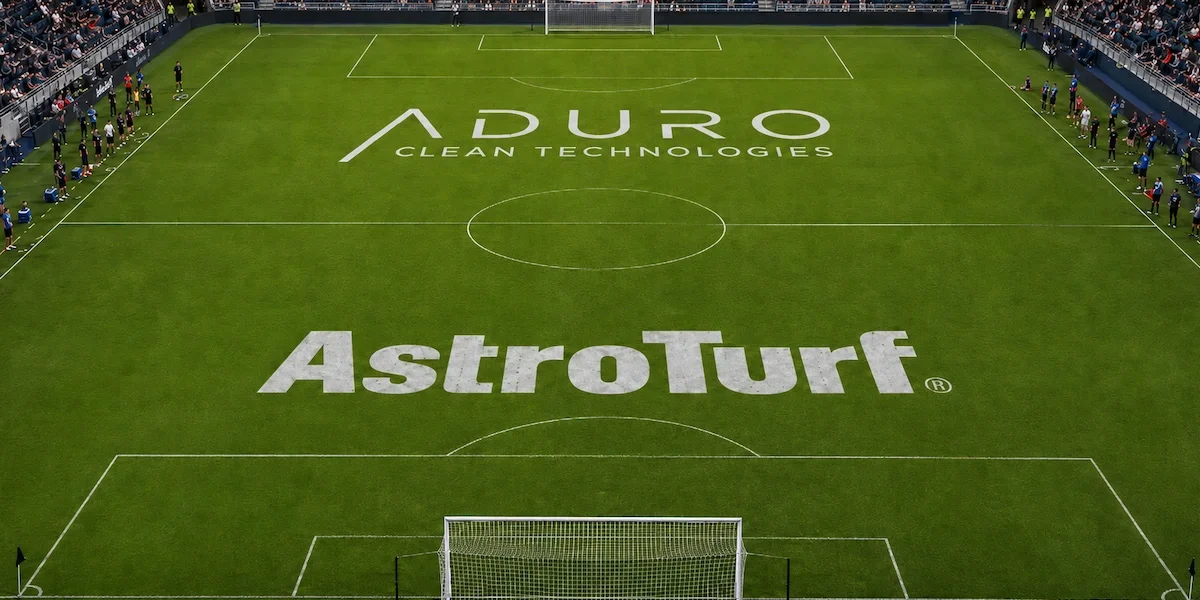
Turf has definite advantages over natural grass, and improving end-of-life recovery only reinforces those advantages. It is possible to turn this wasteful process into an environmental win—and across several industries, that loop is still being built.
Making the case for turf
Why a long-lasting, self-sustaining playing surface can be a real win—with one condition.
The case for turf over traditional grass holds a lot of water—literally. Grass fields require continuous watering and other maintenance to stay playable, especially for fields in dry climates. The Synthetic Turf Council estimates every field it replaces with turf saves between 500,000 and 1 million gallons of irrigation water yearly. Turf fields also stay playable for eight to ten years without the need for expensive grass replacement or chemical treatments for weeds. All of this seems like an environmental slam-dunk for turf, and it is—as long as what comes off the field can be reclaimed or recycled into new material. We see this as an industry-wide opportunity to create effective pathways for recovering and repurposing waste material at the end of a turf’s life cycle.
Retiring a turf field
Just how much material is left at the end of a turf field’s life?
An average full-sized turf field is approximately 80,000 square feet and weighs about 60,000 pounds, including fibers and backing: roughly the same amount of plastic waste produced by 125 households in the span of a year. When multiplied by approximately 13,000 existing synthetic turf fields in the United States alone, not to mention 1,200 to 1,500 new installations being built yearly, that number balloons to over 86 million pounds of waste per year—the same yearly amount of plastic waste plastic generated by all of Long Beach, California. In the EU, the LIFETURF official research initiative estimates a further 20,000 fields, growing 10 percent annually. That’s another 2,000 yearly turf renewals, generating an extra 133 million pounds of turf waste and bringing the combined US/EU total to over 230 million pounds annually. The same research shows only about 10 percent of that material is currently reused or recycled. While industry recycling infrastructure already exists, most of the waste has yet to be captured.
AstroTurf is helping tackle the problem
The industry isn’t starting from zero, but mechanical recycling alone cannot close the loop.
Industry leader AstroTurf has already invested in recycling initiatives of its own, including a dedicated alliance with a turf recycling facility geared to process end-of-life systems, as well as a plastic-circularity initiative designed to divert over 10 million pounds of polyethylene waste from landfills across the country. AstroTurf is not alone: many other manufacturers follow similar playbooks for their mechanical recycling and take-back programs, but none of them have solved the critical problem. To produce turf, polyethylene and polypropylene fibers are bonded into cured backing material that, over time, becomes mixed with infill and field contamination, and degrades with long exposure to light. While mechanical recycling can shred and sort efficiently, it is simply not up to the task of recycling tightly-bonded mixed material.
Aduro and AstroTurf explore collaboration
Where Aduro’s chemistry stands today and what the AstroTurf collaboration is actually testing.
This is where Aduro’s chemistry comes in. Our interest in this initiative is not new: in mid-2025, we tested our proprietary Hydrochemolytic™ Technology (HCT) on turf supplied by an industry stakeholder, and the early results were very encouraging. Polyethylene and polypropylene components of the post-use turf were successfully converted without extensive processing, even with the presence of mixed materials and contamination expected of aging turf systems.
Aduro has also committed to proving HCT in other arenas. Separately, and using a different feedstock, a Next Generation Process (NGP) Pilot Plant campaign posted an 86 percent liquid hydrocarbon yield using a polypropylene feed. While not a turf-specific result, this does represent a general marker of how the chemistry performs at pilot scale.
Aduro’s collaboration with AstroTurf represents a Memorandum of Understanding, rather than a commercial deployment. This is evaluation-stage work: establishing a framework to understand the outcomes of applying HCT to synthetic turf, and how these two companies can evaluate its use in conjunction with mechanical pre-treatment to recycle PE and PP fractions from old turf. The collaboration involves exploring conversion of these polymers into usable liquid hydrocarbon products suitable for feedstock in existing petrochemical infrastructure, with the scope covering everything from field recovery and material separation to cleaning and preparing a fraction for conversion. But this is just one piece of a larger puzzle, not a standalone fix. To quote Aduro CEO Ofer Vicus:
“The goal is to work directly with a recognized name in synthetic turf to better understand the full end-of-life challenge.”
A conversation about turf’s future
The people behind the partnership, in their own setting
Earlier this month, Ofer Vicus joined MLS Commissioner Don Garber and AstroTurf’s VP of Development and Strategy Robert Mitchell for an episode of Bounty Uncharted, featuring a wide-ranging conversation with Jeff Ragovin about the future of turf from the field to the supply chain behind it. It articulates why turf’s future is not being decided by a single company, but through collaboration with the organizations who build it, play on it, and are now determining how to recycle it.
The condition remains
Turf’s case as the superior choice to traditional grass was never without conditions.
Turf’s environmental viability depends on closing the recapture loop at the end of its life. AstroTurf’s existing programs, the parallel efforts of the larger industry, and Aduro’s chemistry – tested directly on turf and advancing at pilot scale – are all pieces of the same unfinished puzzle, and Aduro’s MOU with AstroTurf represents the next piece.
Watch the full Bounty Uncharted conversation above, learn more about the MOU on our investor relations page, and subscribe to Aduro’s newsletter to get the latest updates as the partnership develops.
Sources:
ERDC/CERL TR-19-3, Evaluation of Turfgrass Replacement Options: Artificial Turf (field lifespan)
The Motz Group, "How Much Does a Synthetic Turf Sports Field Cost?" (field size)
landscapecreationslv.com; jcturf.com (turf weight per sq ft)
OECD, "Plastic pollution is growing relentlessly..." press release, Feb. 2022 (household plastic waste)
The New York Times, July 26, 2025; ABC News (US field count, new installs/year)
LIFETURF Project (LIFE19 ENV/EE/000510), European Commission LIFE Programme (EU field count, replacement rate, recycling rate)
Western Resource Advocates (2022) and Synthetic Turf Council estimates (grass field water use)
AstroTurf Corporation, sustainability materials, astroturf.com/sustainability
Aduro Clean Technologies, "Aduro Clean Technologies Investigates Chemical Recycling Pathway for Synthetic Turf Waste," July 31, 2025
Aduro Clean Technologies, "Aduro Reports NGP Pilot Plant Campaign Results, Achieving 86% Liquid Hydrocarbon Yield," June 9, 2026
Aduro Clean Technologies and AstroTurf Corporation, "Aduro Clean Technologies and AstroTurf Sign MOU for Synthetic Turf Recycling," June 30, 2026
Bounty Uncharted episode featuring Don Garber, Robert Mitchell, and Ofer Vicus, hosted by Jeff Ragovin