
Canada is helping shape how chemical recycling is evaluated within circular plastics systems. Europe is beginning to translate similar principles into law.
Ontario has been a global innovator in recycling since the creation of the Blue Box program in Kitchener in 1981, one of the first widely adopted curbside systems in the world. It helped establish the idea that households could play a direct role in diverting materials from landfill, shaping modern recycling programs across North America.
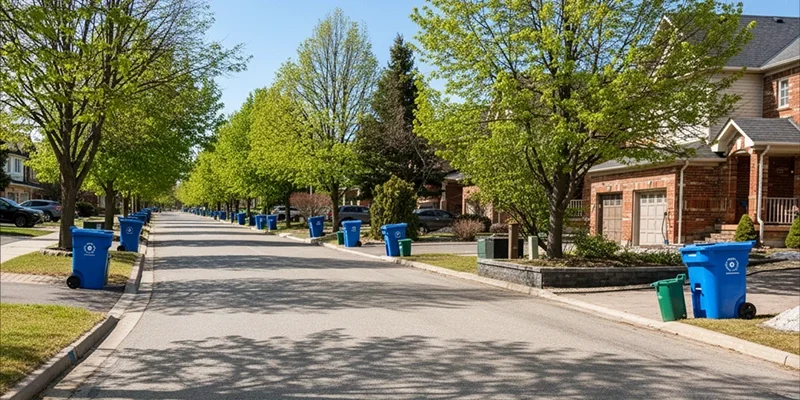
As of January 1, 2026, Ontario has completed a multi-year transition to a producer-run residential recycling system. Under O. Reg. 391/21, the Blue Box Regulation, companies that supply packaging and paper products to consumers are now fully responsible for funding and operating residential recycling. The program is administered province-wide by Circular Materials, a not-for-profit producer responsibility organization, and regulated by the Resource Productivity and Recovery Authority (RPRA).
The result is a more coordinated system in place of a patchwork of municipal programs. That shift is intended to support more predictable material flows, lower contamination, and higher feedstock quality for the mechanical recyclers that process most of Ontario's residential plastic.
At a system level, the transformation is bigger than its parts. Plastics that were once a dispersed waste problem now move through coordinated material streams. This is the foundation for what is sometimes called "urban mining": recovering hydrocarbons already present in everyday materials and returning them to the value chain.
What changed: Producer responsibility and a unified material list
Ontario's Blue Box program was historically operated by municipalities and First Nations communities under a 50/50 cost-share with the producers of packaging and paper. Under extended producer responsibility (EPR), producers now hold full financial and operational accountability. They must also meet recovery targets reported to RPRA.
Just as significant is the new unified material list. Municipalities once set their own rules, leading to dozens of different accepted-material lists across the province. Today, every Ontario community collects the same materials. Several are new to the system, including:
-
Hot and cold paper-based and plastic-lined beverage cups
-
Flexible plastic films
-
Foam packaging
-
Black plastic and plastic lids
For the first time, every Ontario household sees the same list. Consistency at the kitchen counter helps create consistency at the materials recovery facility (MRF). Consistency at the MRF is what allows recovery technologies, mechanical or otherwise, to work more effectively.
In practice, recycling is becoming a connected materials-management system. Collection, sorting, and processing are being aligned to produce defined material outputs.
The flexible plastic challenge
Among the materials newly captured by Ontario's unified list, flexible plastics remain among the most difficult to recover. In September 2025, Ontario finalized amendments to the Blue Box Regulation through O. Reg. 210/25 that reflect this directly. The flexible plastic recovery target is phased in over time, starting at 10% in 2026 and 2027 and rising to 25% by 2032. Up to 15% of a producer's management obligation can be met through energy-from-waste pathways in limited circumstances.
The Ministry's stated reason was practical: the technology and infrastructure to mechanically recycle most flexible plastic at scale do not yet exist.
Those amendments reflect the current technology landscape. Commercially mature chemical recycling processes today are often traditional thermolytic technologies, such as pyrolysis and gasification. These typically operate at high temperatures and can produce significant fuel byproducts alongside plastic-bound output. Other emerging pathways, such as supercritical water processes, achieve different output profiles but require both high temperatures and very high pressures.
These technologies can operate at scale, but many existing pathways still skew toward fuel rather than circular feedstock for new plastics. The direction emerging from Plastics Pact Network guidance is different: chemical recycling should be evaluated by whether it produces circular feedstock for new plastics, with fuel pathways excluded from what counts as recycling.
Closing the distance between today's commercially mature processes and that emerging circular-feedstock model requires continued technology innovation.
Why centralization matters for plastics feedstock
Centralization changes how material flows from curbside to recovery. By aggregating volume across the province, the new system can support larger, more predictable streams of post-consumer plastic. Material definitions are clearer by the time material reaches a sorting facility.
A unified system can also support investment in advanced sorting infrastructure. Modern facilities, including new MRFs that Circular Materials and partners brought online in Cambridge and Greater Napanee, increasingly use high-resolution optical sorting, AI-enabled material recognition, and automated separation. These systems distinguish between plastic polymer types, colours, and formats at scale.
Over time, that kind of infrastructure can shift outputs from mixed waste toward defined material streams that better meet the requirements of downstream processors.
A shared global vision, applied locally
Ontario's reform is one application of a broader circular-economy vision taking shape across jurisdictions. A key starting point is the Ellen MacArthur Foundation's New Plastics Economy framework, which has set out a vision for a global plastics system in which plastics never become waste. The Ellen MacArthur Foundation and the Waste and Resources Action Programme (WRAP) convene the Plastics Pact Network, a group of national and regional initiatives that translate that vision into local action.
The Canada Plastics Pact (CPP) has been an important voice in that network on the role of chemical recycling. Its foundational discussion paper, A Framework for Evaluating the Role of Chemical Recycling to Support a Circular Economy for Plastics in Canada, was developed through engagement with CPP Partners and a broad range of stakeholders. That work was later cited as a foundational source in the U.S. Plastics Pact's November 2025 position on the role of physical and chemical recycling in a circular economy for plastic packaging.
In April 2026, CPP published its public-facing Guidance on the Application of Physical and Chemical Recycling Technologies. That guidance builds on the earlier discussion paper and aligns with related Canadian standards, including CSA R117:24, the National Standard of Canada for plastics recycling definitions, reporting, and measuring, and BNQ 3840-100/2023 for mass balance accounting.
Europe is moving along a related path through binding regulation. The EU's Packaging and Packaging Waste Regulation (PPWR) introduces post-consumer recycled content targets from 2030, formalizes mass-balance accounting rules for chemically recycled content through secondary legislation, and defines a complementary role for chemical recycling alongside mechanical recycling.
These are not identical instruments. CPP guidance, USPP positions, Canadian standards, and EU regulation do not carry the same legal force. But together, they point to a maturing policy architecture: producer responsibility first, recovery targets second, recycled-content requirements third, and complementary recycling technologies defined more clearly as the system develops.
Ontario's Blue Box reform and Canada's broader policy direction sit inside that picture. The Canadian system is at an earlier stage of regulatory maturity than the PPWR, but it is moving along a similar arc.
Aduro is a CPP partner. We participate in the working groups and consensus-building processes that help shape how these frameworks, definitions, and performance expectations develop in Canada.
Where chemical recycling fits
Mechanical recycling remains the foundation of plastics recovery in Ontario. It works well for many rigid plastic containers and packaging formats. But mechanical recycling cannot process all plastics. Flexible packaging, multi-material formats, and certain food-contact applications can fall outside what it can recover economically, at scale, or within a given geography.
The CPP Guidance places physical and chemical recycling within a clear hierarchy. Reduce, reuse, and mechanical recycling come first. Physical and chemical recycling are intended for the materials those higher tiers cannot address.
The Guidance also draws a clear line on outputs: material recycling must produce feedstock for new plastics to be recognized as recycling. Plastics-to-fuel pathways are not treated the same way. This aligns with CSA R117:24, which states that combustion for energy recovery shall not be considered a recycled output of the recycling process. The U.S. Plastics Pact (USPP) November 2025 position paper draws a similar line, and PPWR secondary legislation under development in Europe is structured around the same distinction.
The CPP framework evaluates technologies across four pillars: operational transparency, environmental impacts, community and human rights impacts, and complementarity to mechanical recycling. Twenty-two performance indicators sit beneath those pillars. The framework is built on, and adapted from, the Ocean Plastics Leadership Network's 2024 Responsible Production Guidelines for Advanced/Chemical/Molecular Recycling.
That is the context in which Aduro's Hydrochemolytic™ Technology (HCT) is being developed.
HCT is being designed to convert post-consumer plastics, including PE, PP, PS, and multi-material formats, into hydrocarbon intermediates intended to re-enter the value chain as feedstock for new plastics. The process operates at relatively low temperatures and moderate pressures in an aqueous medium, using proprietary catalysts and in-situ hydrogenation.
Compared with many traditional thermolytic processes, HCT is being designed to run on lower input energy and to produce a higher yield of plastic-bound hydrocarbon output with a smaller fuel fraction. It can also accommodate a degree of feedstock variability, which may provide operational flexibility as Canadian sorting infrastructure continues to develop.
Another design aim is to produce outputs that require less post-treatment than pyrolysis oils, which generally need hydrotreatment and distillation before they can be used as feedstock for downstream chemical processes. Initial testing and feedback from a steam cracker licensor have been encouraging, and validation will continue through the NGP Pilot Plant and at first-of-a-kind commercial scale.
These design characteristics align closely with the criteria CPP prioritizes. Lower intended energy input would need to be demonstrated through lifecycle assessments under ISO 14040 and ISO 14044. Higher intended feedstock yield and a smaller fuel fraction would also support mass balance accounting methods where fuel allocations are deducted from recycled-content claims.
As HCT continues to be validated, reduced post-treatment requirements could further strengthen the technology's lifecycle profile. The broader objective is clear: to produce the kind of circular feedstock that emerging Plastics Pact Network frameworks recognize as recycling.
Looking ahead
Ontario's Blue Box system began as a globally recognized model for collecting recyclable materials. More than four decades later, the province is again changing how recycling works, moving from collection as a service toward materials management as a system.
The system is still maturing. Industrial, commercial, and institutional plastics sit outside the residential program. Recycled-content requirements in Canada are still in development. The standards referenced in the CPP Guidance, including CSA R117:24, have not yet been adopted as federal policy. The technology and infrastructure to recover certain plastic streams, including flexible films, continue to scale up.
These are familiar features of a producer-run residential recycling system in its first operational years.
Aduro is scaling HCT in step with the policy direction that defines where chemical recycling fits. As a CPP partner, we contribute to the work that translates circular-economy principles into Canadian guidance, definitions, performance standards, and consensus positions.
As Ontario's recovery targets ramp, as Canada's recycled-content rules take shape, and as Plastics Pact Network frameworks continue to evolve, Aduro's role is to operate within those systems and help produce circular feedstock for new plastics.
Ontario helped establish the Blue Box as a model for curbside recycling. The system now being built, together with parallel work across the global Plastics Pact Network, is helping create the conditions for the next stage of plastics circularity: one where policy, infrastructure, sorting, and advanced recycling technologies work together to recover more value from materials already in circulation.